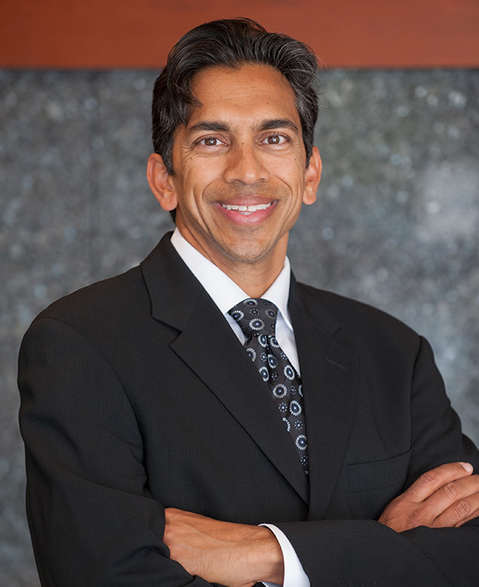
Medically Reviewed by Max Parikh, M.D. NVISION Surgeon
The 3 Biggest Fears About LASIK — And What the Research Actually Shows
Medically Reviewed by Max Parikh, M.D. NVISION Surgeon

Article At a Glance

A 2026 clinical study of 300 LASIK patients — co-authored by NVISION’s Dr. Max Parikh and published in Clinical Ophthalmology — measured real-world outcomes at 12 months post-procedure. The headline numbers: 95% were completely or very satisfied with their vision, 98% would choose LASIK again, and zero patients reported being dissatisfied. Visual disturbances like halos and glare were rarely bothersome, and the average dry eye score at one year fell well within the normal, asymptomatic range.
The study’s strong results reflect careful patient selection as much as advanced technology — participants were screened out if they had pre-existing dry eye or corneal irregularities. That’s the point: LASIK’s outcomes are best understood in the context of appropriately selected candidates. If you’ve been on the fence because of things you’ve read online, this study offers a more grounded picture of what modern LASIK actually looks like for most patients.
If you’ve been thinking about LASIK, chances are you’ve done some research — and maybe found a few stories that gave you pause. Night halos. Persistent dry eyes. Wondering whether you’d actually be happy with the results.
Those concerns aren’t unfounded. They come up because they reflect real, documented side effects that some patients experience. The honest answer is that LASIK, like any surgery, carries risks.
But “some patients experience this” is a very different statement from “you will probably experience this.” And that distinction matters enormously when you’re deciding whether to move forward.
A 2026 clinical study — co-authored by NVISION’s own Dr. Max Parikh and published in Clinical Ophthalmology — surveyed 300 LASIK patients roughly 12 months after their procedures to find out what their experience was actually like. Here’s what the data showed.
About this study: Lobanoff MC, Mann PM, Parikh M, et al. “Multi-Site Study of Patient Reported Vision Quality and Dry Eye Following LASIK.” Clinical Ophthalmology. 2026;20:566803. This was a multicenter, IRB-approved observational study of 300 patients who had WaveLight LASIK for myopia or myopic astigmatism.
- 95% completely or very satisfied with vision at 12 months
- 98% would choose to have the procedure again
- 98% would recommend LASIK to a friend or family member
- 97% said LASIK improved their quality of life
Fear #1: “I’ll have halos, glare, or starbursts — especially at night”
This is probably the most common concern people bring to their consultation. And it’s a reasonable one — older LASIK techniques did produce a higher rate of visual disturbances, and some of those stories are still circulating online.
Modern LASIK has evolved significantly. Wavefront-optimized and topography-guided treatment plans take into account the unique curvature and characteristics of your individual cornea in a way that earlier procedures didn’t. The study used the WaveLight EX500 laser with both of these approaches.
You deserve clear vision. We can help.
With 135+ locations and over 2.5 million procedures performed, our board-certified eye surgeons deliver results you can trust.
Your journey to better vision starts here.
What the research found
The study used a standardized questionnaire (the PROWL) to ask patients how often they experienced four types of visual disturbances: double images, glare, halos, and starbursts. Here’s the breakdown on bothersomeness — because frequency matters less than whether it actually affects your life:
Percentage of patients who rated each disturbance as “extremely” or “very” bothersome:
- Double images: 0%
- Glare: 2%
- Halos: 1%
- Starbursts: 3%
Starbursts were the most commonly reported disturbance — 11% of patients said they experienced them “always” or “often” — but even among that group, the vast majority did not find them significantly disruptive to daily life.
On the question of driving — one of the most practical tests of how visual disturbances affect real life — 94% of patients said they had “no difficulty at all” driving during the day, and 54% said the same for driving at night. Night driving is where visual disturbances tend to be most noticeable, so that 54% figure is worth noting; roughly half of patients reported some degree of nighttime driving difficulty, even if most described it as “very little.”
The takeaway: significant, life-disrupting visual disturbances following modern LASIK are uncommon. If you do experience halos or glare in the months after surgery, the odds are high that they’ll be mild, manageable, and improve with time.
Fear #2: “LASIK will give me permanent dry eye”
Dry eye after LASIK is real. The procedure temporarily disrupts corneal nerves that contribute to tear production, and some patients experience dryness during the healing process. What people often wonder is whether that dryness goes away — or whether it becomes a long-term condition they’re managing indefinitely.
There’s some important context here too: dry eye is already common in the general population, and many people who seek LASIK already have some degree of pre-existing dryness. The baseline matters.
What the research found
The study measured dry eye using the Ocular Surface Disease Index (OSDI), a validated questionnaire that clinicians use to assess dry eye severity. A score below 12 is considered normal (asymptomatic).
8.7 — Mean OSDI score at 12 months post-LASIK — well within the range indicative of a normal, healthy ocular surface. For reference, a score above 33 would suggest severe dry eye.
72% of patients scored below 12 on the OSDI, meaning the majority were fully asymptomatic for dry eye at the one-year mark. 42% were using artificial tears — most just once per day — and only 4% were using prescription dry eye medication.
91% of patients said they “never” or “rarely” experienced changes in visual clarity throughout the day, which is one of the more noticeable daily manifestations of dry eye.
These results are consistent with other published research. A separate 12-month study reported nearly identical OSDI scores following wavefront-guided LASIK, and a 6-month prospective study found that dry eye symptoms following topography-guided LASIK were relatively low and had actually improved from the pre-operative baseline.
The bottom line: for most carefully selected patients, clinically significant dry eye following LASIK is uncommon at the one-year mark. If you have significant pre-existing dry eye, that changes the calculation — which is exactly why a thorough pre-operative evaluation matters.
Fear #3: “What if I’m not happy with my vision after?”
This is the fear underneath all the other fears. You can tolerate some halos. You can manage dry eye with drops. What people are really asking is: will I regret this?
That’s a fair question, and it deserves a direct answer.
What the research found
Patient satisfaction was the primary endpoint of this study — the main thing the researchers set out to measure. They used the same PROWL questionnaire that the FDA used in its landmark PROWL-1 and PROWL-2 studies.
95% of patients reported being “completely satisfied” or “very satisfied” with their vision at approximately 12 months. The remaining 5% were “somewhat satisfied.” Zero patients reported being dissatisfied.
The other numbers point in the same direction: 98% said they would have the procedure again. 98% would recommend it to a friend or family member. 97% said it improved their quality of life.
“The results suggest high patient satisfaction of vision approximately 1 year following Wavelight LASIK. Visual disturbances were rated low in frequency and in bothersomeness.”
It’s worth putting this in context. A 2024 systematic review and meta-analysis found an overall dissatisfaction rate of 2–6% among post-LASIK patients across the published literature. This study’s zero-dissatisfaction result is on the favorable end of that range, likely reflecting the careful patient selection criteria and the capabilities of current technology.
No study can predict your individual outcome. But the consistent pattern across multiple published studies using validated questionnaires is that the overwhelming majority of appropriately selected LASIK patients are glad they did it.
A word on patient selection
One reason this study’s outcomes are strong is that it reflects outcomes in patients who were good LASIK candidates to begin with. Participants were excluded if they had pre-existing dry eye, corneal irregularities, or other conditions that would increase their risk profile.
This is exactly how LASIK should work. The pre-operative evaluation isn’t a formality — it’s the most important step in the process. Patients who aren’t good candidates are identified before surgery, not after. That’s what protects the outcomes you see in studies like this one.
If you’ve been told in the past that you’re not a LASIK candidate, it’s worth having a current evaluation. Technology has advanced, and candidacy criteria have evolved. If you haven’t been evaluated, that conversation is where everything starts.
Ready to find out if you’re a candidate?
A comprehensive LASIK evaluation at NVISION is the first step. Our physicians will give you an honest assessment — including whether LASIK is right for you.
Schedule Your Free Consultation
As the founding partner of the Advanced Ophthalmology Institute in 1999 and the former Los Angeles (previously San Diego) Chargers’ team ophthalmologist for over a decade, Dr. Parikh knows the value of precision and outcomes in vision enhancement surgery. He is a co-author of a 2026 peer-reviewed study published in Clinical Ophthalmology on patient satisfaction and vision quality following LASIK, which found that 95% of patients were completely or very satisfied with their results at one year post-surgery.
This content is for informational purposes only. It may have been reviewed by a licensed physician, but is not intended to serve as a substitute for professional medical advice. Always consult your healthcare provider with any health concerns. For more, read our Privacy Policy and Editorial Policy.